Introducing Demi Build
Game Development Studio, Open Source Tools, AI Research

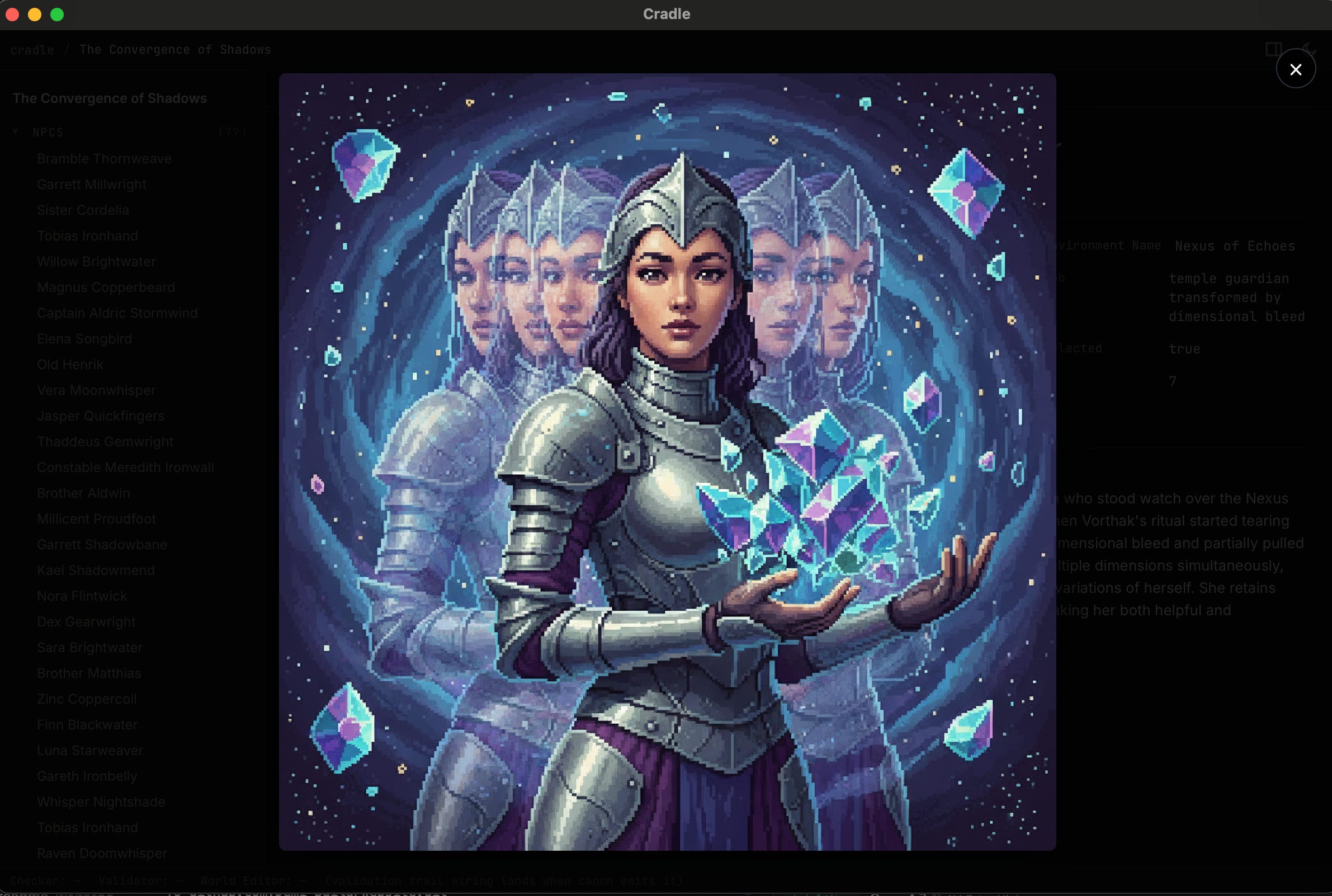
"The boundaries... dissolve... I see/saw/will see you across seventeen different moments..."
This is Thessa the Shadewalker. A temple guardian caught in the first dimensional bleed when the convergence began, she now exists partially in multiple realities at once. She stands at coordinates (7, 13) in the Nexus of Echoes. She speaks in overlapping voices. Her hobby is collecting fragments of reality that fall through the rifts. She has nine exchanges in her before she goes quiet, and a portrait that flickers between solid and shadow.
Thessa was not written. She was generated, along with 78 other NPCs, 95 items, 31 monsters, 33 quests, 481 events, four character classes, and the music and sound effects that play around her. All of it came from a single paragraph of story seed and a random number.
What Demi is
Demi is an atelier for game development: a small studio that ships games, an open source toolchain that makes those games possible, and a research arm working on the models underneath.
The studio is called Demi Studios. It shipped MazeWorld in April 2025 and is releasing a second title in late June. The toolchain has two pieces: Canon, a Python library for orchestrating AI-generated structured content, and Cradle, a desktop IDE that sits on top of it. The research arm is early. Two threads are live, and the first writeups land over the next two weeks.
The bet underneath all of it is that a small team with the right tools can ship the kind of ambitious, strange games that defined the early 2000s, at modern scope, on modern hardware. The bottleneck worth solving is coherence at scale. The rest of this post is what we’ve built toward it so far.
The studio
Demi Studios is a passion project, totally part-time. We are engineers building our own games on top of our own open source tools (Canon and Cradle), using the work to find out where the tools break. The studio exists to be the forcing function for everything else. If we cannot ship a game with these tools, the tools are wrong.
MazeWorld shipped in April 2025. It is a 2D RPG where every NPC, quest, item, portrait, and sound is generated from a single STORY_SEED string. You pick a class, a warrior, cleric, mage, or mysterious gambler, and drop into a labyrinth you have never seen before. White walls, black background, fog of war. Friendly NPCs, hostile ones, puzzles, events, monsters. The conceit of the world is designed by you: set up ancient technology, or mysterious magic, combat a shadowy underworld, it is yours to craft and explore. The point of MazeWorld was to prove the loop end to end. It does.
Our next title is a platformer, shipping late June. You play Urge, moving through a ringworld in search of a truth hidden in plain view. Different genre, engine, and play style. Same toolchain.
The open source
The toolchain has two pieces, both open source, both shipping under the Demi-Build org on GitHub.
Canon is a Python library for orchestrating AI-generated structured content. You bring your own LLM and your own data schemas. Canon brings the templates, the agent patterns, the skeleton-driven generation, and the three-stage validation pipeline that catches incoherence before it reaches the player. The shape of a first session is short: give Canon a seed and a paragraph of story, and twenty minutes later you have a world’s worth of NPCs sitting inside an environment, world-aware, with static dialogue trees that sound like they belong there. Thessa came out of a Canon run. So did the other seventy-eight NPCs in that world.
Canon is not yet on PyPI. The repo and pip release are targeted for early June. If you want to read the code you can follow its progress at github.com/Demi-Build/canon.
Cradle is the IDE on top of Canon. Where Canon is the orchestration layer, Cradle is where you sit and work. It reads Canon-generated worlds and shows you the NPCs, items, classes, mazes, and the story beats connecting them, as a graph and as structured data you can navigate. v0.1 is read-only and ships today for Windows, macOS, and Linux. v0.2 brings full editing: change an NPC, regenerate a quest, rewire the connections, and write the result back to your project. The longer arc is engine-agnostic glue code between Canon’s output and whatever engine you ship in. The north star is that a writer, an artist, an animator, or any member of the dev team should be able to open Cradle without ever touching the Canon API and do targeted work on their world.
Cradle v0.1 is at github.com/Demi-Build/cradle.
The research
Demi Research is the earliest of the three pillars. There are currently three threads in development.
The first is small fine-tuned models, in the 3B to 8B range, trained for narrative coherence. The question we are working on is whether a model that small, tuned on the right data and evaluated against a hybrid of rule-based checks, model-graded judgments, and held-out evals, can do the coherence work that today gets handed to frontier models. If it can, the implication is that the kind of generation Canon orchestrates can run on a developer’s laptop, and eventually inside a shipped game, without an API call.
The second is game intelligence. We want NPCs who behave like inhabitants of a world rather than windup dolls for the player. That decomposes into three questions:
Can an NPC hold coherent memory of the player, of world events, and of other NPCs across a long play session without drifting?
Can NPCs respond to emergent change, another NPC dying, the player’s reputation shifting, a faction collapsing, in ways that feel authored rather than reactive-by-template?
Can NPCs hold relationships with each other independent of the player, so the world keeps moving when the player is not looking?
Thessa is a static NPC. The version of Thessa we want is one whose seventeen overlapping moments include the ones you just lived through with her.
The third is compact diffusion architectures for content-bounded generation, the kind that could plausibly run at load-time or in-engine. The question there is whether you can ship a small package that produces high-resolution assets at runtime, instead of shipping the assets themselves.
These are all still in the planning phases or active areas of research - but have yet to yield results. However, as we continue to build and do research we’ll publish both what we’re working on, how the research yields results, and our learnings as we develop Cradle, Canon, and our Studio Games. Our next few writings will include the manifesto of Demi - why now and what our goals are; Skeleton-driven generation, why we pre-roll mechanical properties on dice and let the model fill only name and flavor; and then world bibles versus context windows, what we learned shipping MazeWorld about which structural fixes actually move coherence and which ones don’t.
Where to find us
Demi is a side project that intends to earn the right to be more than that. The way it earns that right is by shipping games and tools.
If you want to play the work, MazeWorld v0.0.1 is at github.com/wolfgangjblack/MazeWorld/releases. Builds for Windows, macOS, and Linux. Urge ships in late June.
If you want to read or run the tools, Canon is at github.com/Demi-Build/canon and Cradle is at github.com/Demi-Build/cradle. Canon’s pip release is targeted for early June. Cradle v0.1 is downloadable today.
If you want to follow the research, the first writeups land here over the next few weeks.